The Dawoodi Bohras launched eye health programme for 20,000 school children in West Bengal and Madhya Pradesh
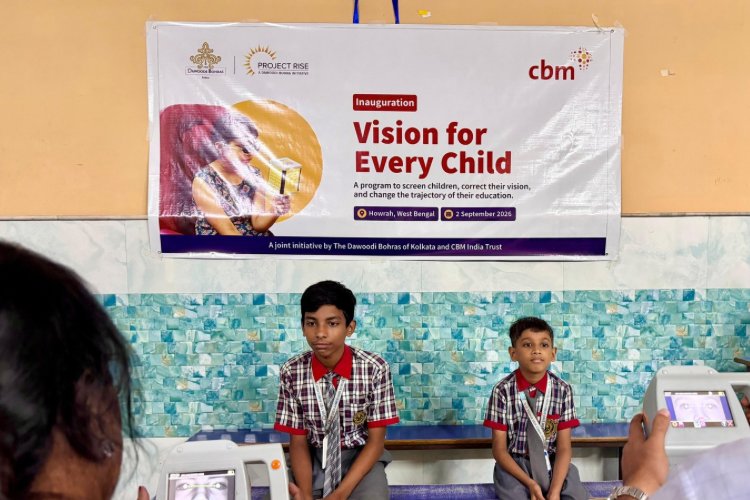
The four-month programme will cover more than 30 government schools, providing free spectacles, specialist referrals, treatment support, and training for 200 teachers.
In an effort to ensure that vision difficulties do not stand between children and their education, the Dawoodi Bohra community's global philanthropic initiative, Project Rise, has launched the "Vision for Every Child" initiative in partnership with CBM India Trust. The four-month inclusive school eye health programme was formally inaugurated at the Burhani Complex at Topsia Road, followed by an initial screening camp at Sir Syed Ahmed High School.
Under this initiative, 20,000 students across more than 30 schools will receive eye screenings, with spectacles to be provided free of cost to children who need them. The programme will also facilitate specialist referrals and support paediatric surgeries for children diagnosed with conditions requiring further treatment.
The launch was attended by Sony Thomas, Executive Director, CBM India Trust, Tapas Roy, Deputy Superintendent of Police, West Bengal Police, Dr. Ratish Chandra Paul, Medical Director and Secretary, Susrut Eye Foundation and Research, Ashok Chaki, Secretary of Special Olympics, representatives of His Holiness Syedna Mufaddal Saifuddin in Kolkata, doctors, teachers and members of the Dawoodi Bohra community in the city.
Taher Totanawala, Project Rise coordinator for the Dawoodi Bohras of Kolkata, said the initiative brought together two areas His Holiness Syedna Mufaddal Saifuddin has consistently emphasised: health and education. “A child should not fall behind in school because a treatable vision problem has gone unnoticed,” Taher said. “His Holiness has consistently encouraged members of the Dawoodi Bohra community to contribute to the wellbeing of the societies in which they live, particularly through sustained work in health and education. Through this partnership, we hope children who need eye care are identified early and receive the support and treatment they need.”
Sony Thomas, Executive Director of CBM India Trust, said effective school eye health programmes need to extend beyond screening. “Screening is the first step. What matters is ensuring that a child who needs spectacles, specialist care or surgery receives it, along with the necessary follow-up,” Thomas said. “Vision for Every Child has been designed around this complete pathway of care. We are pleased to partner with Project Rise to bring these services closer to children in Howrah and Sehore.”
Alongside screening and treatment support, the programme will provide preventive eye-health education to students. Teacher training imparted to more than 200 teachers will focus on recognising signs of possible visual impairment in the classroom, including children who have difficulty reading from a distance or repeatedly struggle with classroom material. The programme’s emphasis on early identification, referral and follow-up also reflects wider national efforts to address childhood vision impairment through school and child-health interventions.
Mohtasheem Sulaiman, Principal of Sir Syed Ahmed High School, involved in the screening drive, said many of the cases found among the first children examined were straightforward to treat. "Some of these children had been struggling to read the blackboard for a while, simply because no one had thought to get their eyes tested," he said. "Most of these conditions are quick to detect and easy to correct with a pair of spectacles, but without a screening programme like this, they can go unnoticed for longer than they should."
Some of the government schools covered under this programme include Khila Gopimohan Sikshaya Sadan, Talbandi Belayet Ali High School, Brahmampara Chintamani Institution, Nayachak Jadunath High School, Dafarpur Prabartak Vidyamandir, Liluah TRG Khemka School, and Howrah Urdu Girls High School, to name a few.
A common but often overlooked barrier to learning
Uncorrected vision problems often remain one of the more quietly persistent obstacles to school performance, where large numbers of children, particularly in low-income and rural households, go undiagnosed simply because a routine eye test is out of reach. The effects are rarely dramatic on their own; a child who cannot see the blackboard falls behind, loses confidence, and in some cases drops out altogether, long before anyone identifies poor eyesight as the cause.
The programme has been designed to align with two existing government schemes, the National Programme for Control of Blindness and Visual Impairment (NPCBVI), India's decades-old blindness-control effort, and Rashtriya Bal Swasthya Karyakram (RBSK), the child health screening scheme run through the National Health Mission, so that the "Vision for Every Child" initiative's impact is easier to sustain.
About Project Rise
Project Rise is a global initiative of the Dawoodi Bohra community dedicated to supporting vulnerable communities through programmes focused on healthcare, education, food and nutrition, water and sanitation, environmental conservation, and social development. Launched in 2018, Project Rise works with community volunteers, local authorities, and partner organisations to develop initiatives responsive to local needs.
 Disclaimer: Welthi.com does not guarantee any specific results as a result of the procedures mentioned here, and the results may vary from person to person.